


Our Guide to Corrugated Cardboard Grades
Back to the BiG BLOG
Corrugated cardboard is a known favourite with businesses looking to protect their products during transit and with the packaging industry in general. There are many reasons why an overwhelming majority of people choose cardboard to package items – it is sturdy, secure, reliable, and cost-effective. However, how do you know that you are using the best type of corrugated cardboard for your goods? A lot of company owners don’t ever consider the elements that determine the strength or price of the cardboard that they use, alongside how it is manufactured and the impacts that these factors can have on whether your packaging arrives in good condition or not.
All of this doesn’t even include what the different names for corrugated cardboard stand for, for example, B-Flute and Test Paper. What does it all mean? We have put together a complete guide all about corrugated cardboard, how it's made, along with the different thicknesses and classifications, to help you understand which type you should be buying for your business.
How is Corrugated Cardboard Manufactured?
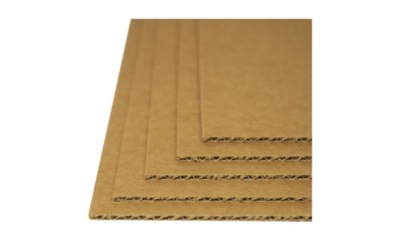
First thing’s first, let’s understand how corrugated cardboard is formed before it is used for packaging. A standard sheet of cardboard consists of three different components: a sheet of fluted material – meaning it is made by having a ridged, crimped or grooved pattern – sandwiched between two layers of paper. The paper that the fluting is glued between is also known as the inner and outer liners. Each side of the flute is glued to the inward-facing part of the liners, creating a crush-resistant, rigid, stable, and strong piece of corrugated cardboard ready to be formed into parcels.
The Different Types of Paper Used
To go with the different grades of cardboard, there are different paper options when it comes to building a corrugated cardboard sheet. The paper that corrugated cardboard is made from can impact the performance of the board as a container. The most popular paper choices for the three outer, inner and corrugated liners are either Kraft or Test paper.
Kraft Paper: Kraft is made from softwood trees. It is considered a virgin material. Due to the make-up of the substance consisting of virgin fibres, it is the strongest type of paper and the easiest to print designs on. With all of these factors considered, Kraft is the most commonly used outside liner when selecting material to produce corrugated cardboard boxes.
Test Paper: This variant of paper is a double-layered or duplex style of paper. Because test paper is a recycled material, it is not as strong as Kraft nor as easy to print anything on to but is a cheaper source than Kraft paper, so it most commonly takes form as the inner liner.
Despite Kraft and Test paper being the most popular liner materials, there are several other options available that businesses can choose to use, each type includes a different grade to make them more easily identifiable:
- Kraft (K) = Virgin Kraft paper
- Test 3 (T) = Fully recycled liner
- Semi Chem (SC) = Virgin fibres using a neutral sulphite semi-chemical process
- Waste Based (WB) = 100% recycled fibres
The final two papers named are most commonly used for flutes, not so much for liners. It is important to note that this list does not name all papers that can be used for corrugated cardboard, as there are also numerous other specialist papers available.
What is GSM and What are the Paper Weight Variances?
After deciding on which paper could be the correct choice for your packaging, it is also essential to consider the weights of the paper. The weight is measured the same way for every form of material, on all packaging websites or office stationery, it is common to see the unit ‘gsm’ printed on paper items and their containers. The expression gsm is an abbreviation of Grams per Square Meter, meaning, if you took a square meter of the paper and weighed it, the result you end up with is the grams of that particular paper for one square meter. So, for example, when you see corrugated cardboard made from 125gsm Kraft Paper, it is often referred to as 125K within the packaging industry.
Other common paperweights include 125 GSM, 150 GSM, 200 GSM and 300 GSM. As said previously for the paper types, paperweights are not restricted to those named above and other weights may be available depending on who or where you are requesting your corrugated cardboard from.
All the information provided so far in this blog allows abbreviations to be created for the varying types of boards. For instance, a sheet of board with a 150 Test outer lining, plus a 150 Test inner lining, with an E flute sandwiched in the middle would be named 150T/E/150T. These abbreviations make it easier for any packaging manufacturer and yourself to fully understand the type of material your cartons are composed of.
Walls, Flutes and their Applications
Before we begin listing all of the flute types and the different applications, it should be mentioned that corrugated cardboard is also available with different thicknesses:
Single Wall: This type of corrugated cardboard has one piece of flute glued between the inner and outer layer of paper.
Double Wall: Adding an extra flute and sheet of the paper liner to a single-wall board creates a double-wall, this adds extra stability and sturdiness to the packaging material.
Triple Wall: Like with double-wall, triple-wall (or Tri-Wall) corrugated cardboard glues another piece of flute and liner to the sheet, this is helpful for the transportation of heavy or large items.
The other aspect of corrugated cardboard that affects a box’s performance is the flute type. The flute is the ridged section glued between the two liners. The height of this material can be changed – and therefore it alters the size of the flutes – which enables the corrugated cardboard to achieve different performance characteristics. These flute variations can range from finer classifications of flute such as E which are useful as lightweight retail cartons as they are also easy to print detailed designs on to, to a more heavy-duty flute such as A or B which are used for transit packaging due to them being able to withstand potential damages.
If you choose to use double-wall material, you can combine different flutes to create a grade such as EB or BC, you can continue to mix flute types with triple-wall cardboard as well. Mixing flutes can offer a rigid structure perfect for storing or transporting heavier items, whilst also allowing the possibility of being printed on to create a more appealing parcel for customers to receive.
Flute Weights and Sizes
Weights – Just like with liner paper, fluting is also weighed by Grams per Square Meter (gsm). The typical weights for fluting include:
90 GSM WBF
105 GSM WBF – This weight is the most common flute used for standard board
112 SC and WBF
150 SC and WBF
175 SC and F
Sizes – There is also a range of flute profiles or sizes used within the packaging industry, these are as follows:
E FLUTE: 1.5mm
B FLUTE: 3mm
C FLUTE: 4mm
BC FLUTE: Double Wall – 6mm – The combination of B and C flutes
EB FLUTE: Double Wall – 4.5mm – A mixture of E and B flutes
E Flute: E flute measures between 1mm to 1.5mm in thickness, making this type of flute a very fine flute. Despite that, it has an excellent compression strength and resistance to crushing or damages, but also provides a high-quality surface for printing. With these characteristics considered, it is commonly used smaller cartons that need good quality prints on them.
B Flute: This flute variation is most commonly used within the packaging industry for the transportation of goods. It has a 3mm thickness, is extremely versatile and can be used in both die-cutting and regular case-making processes. Using cartons made from this flute is an effective and efficient option.
C Flute: C Flute is noted of being between 3.5mm and 4mm in thickness, it provides greater compression strength for items than B Flute. As a result, this form of the flute has a greater stacking strength if it is used for lightweight products, however when storing heavier items it can be prone to crushing.
BC Flute: Ranging between 5mm – 6mm in thickness, this double-wall material combines both B and C flutes. This enables the box to provide a higher amount of protection to goods during transit and will remove stress from businesses due to not having to worry about the potential impairment of products during shipping. Only basic prints tend to be added to this flute to ensure that the strength of the box is not compromised.
EB Flute: EB Flute is approximately 4mm to 4.5mm thick, this corrugated cardboard grade combines E and B flutes into a double-wall material. Due to utilising both a very fine (E) and relatively large (B) flute, this grade provides the perfect balance between transit protection, strength and the ability to have decent designs printed onto the carton.
Industry Terminology Explained
Across Flute – This is a unit of measurement for corrugated boards. It relates to the width of the flute.
Backing Liner – A compressible material attached to the liner to improve the finish, water-resistance and strength of the corrugated cardboard.
Blank – A flat piece of corrugated board that has been cut and scored, usually the finishing touches before the material is transformed into a box.
Board grade – A grade given to corrugated board based on the weight and type of outer liner, flute type, and weight and type of inner liner.
Carton Board – Board with medium to high compression and moisture resistance. It is not solid or fluted like you would find with corrugated cardboard.
Chop Edge, Chops – The length of the board or sheet.
Clay Coat – A thin layer of kaolin – a soft white clay – coated onto the corrugated board to improve printing capabilities and finish.
Corrugated – A material that is shaped into a consistent pattern of parallel ridges and grooves.
Crush – This is a measurement of the cardboard’s resistance to being crushed.
Deckle – The width of the board being corrugated.
Double Wall Board – Two layers of corrugated material that are glued together to increase the board’s overall strength and stability.
Duplex – A double-walled board where the outer layer is coated to make it more water-resistant.
Edge Crush Test – A corrugated board strength test of vertical crush resistance.
Enhanced Fluting – Fluting that adds strength and performance to the material.
FEFCO – The European Federation of Corrugated Board Manufacturers: a non-profit organisation that represent the interests of the corrugated industry.
FEFCO Case Codes – Standard design patterns used within the corrugated industry.
Fibre, Moulded Pulp – The substances that packaging materials are made from.
Flute – The central layer sandwiched between the inner and outer layers of paper in the corrugated board that provides boards with strength and rigidity.
Fluting Profile – The shape of the flute corrugations.
Grammage (GSM) – The measurement for the weight of paper that refers to grams per square metre.
Kraft – Paper produced from virgin pulp made out of natural softwood fibres.
Light-weighting – The design of packages to reduce material use, weight, cost and environmental impact.
Liner – The two layers of paper in the corrugated board that are attached to the flute.
Mottled – Paper liner with an off-white appearance.
Single Face – A piece of fluting glued to only one liner.
Single Wall – Corrugated board involving one fluted paper surrounded by two liners.
Slit Edge – The width of the material.
Test Liner – Recycled liner board.
Tri-Wall – Corrugated board with three flutes sandwiched between four liners providing incredible strength, security and crush resistance to boxes.
Virgin Material – A previously unused and unrecycled material.
So, there you have it…
We hope that we have helped you understand more about the terminology used within the packaging industry for corrugated cardboard and what grade is best suited for your products.

Contact Us
Looking for a bespoke solution? Speak to our Business Solutions team to find out more.